Ashley Meadows
September 27, 2023




If you’re a manager or a team leader, then you know the “joy” that comes with having to write up performance reviews. Employee evaluations or performance reviews are incredibly important — they let you as an employer convey your satisfaction or dissatisfaction with an employee’s performance, paving the way for improvement. But they also take a lot of time and effort. And giving bad news just isn’t fun. You need to give meaningful feedback that addresses any shortcomings in your individual employees.
Unfortunately, you also have to give honest feedback that doesn’t come across as too harsh or make you look like a doormat. If only there were employee evaluation examples you could turn to and change as needed to fit with your company culture and company goals…
In this article, we’re going to go through five options, as well as three pros and three cons of each. We’ll look at:
360 degree feedback
Management by objectives (MBO)
Behavioral observation scale (BOS)
Graphic rating scale
Critical incident method (CIM).
After reading our comprehensive guide, you’ll be able to pick the style of employee evaluation that’s right for your goals.
360 degree feedback
360 degree feedback is a type of performance review where the team member receives constructive criticism and commentary from their management, a group of their peers, and even customers. Like the name suggests, it’s feedback from all sides, which can be a curse and a blessing.
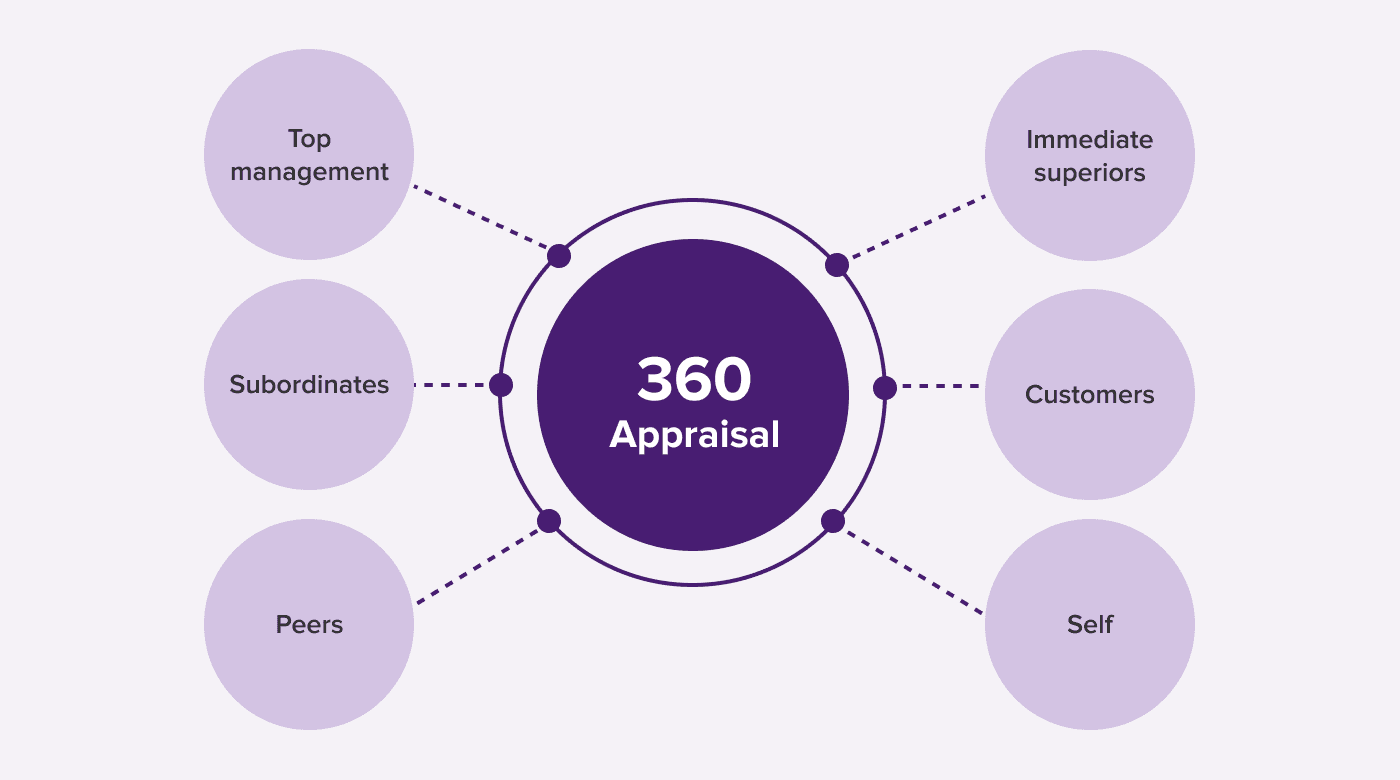
The idea behind this method is that the person receiving the feedback will understand their own strengths and weaknesses from not just one or two, but from multiple different perspectives. Recent estimates show that 85% of Fortune 500 companies use this method in leadership development programs.
Pros
It encourages building a plan for personal development within the company. No one wants to be treated like a commodity.
There’s no such thing as “one size fits all,” at least when it comes to personal development. This method will make each employee feel like they have value beyond their job title.
It improves working relationships. If each team member knows how their colleagues work best, they can come up with solutions based on each other’s strengths, strengthening the team and productivity.
It promotes an open dialog regarding feedback results. While the employee being evaluated may not speak to everyone involved — and risk it becoming a five-act opera — if they can try not to take the feedback they receive personally, they can quickly grow and strengthen their team.
Cons
It can be time-consuming to administer. Depending on how many people are involved, this can be like herding cats, especially if the management team chooses to get customers involved as well.
It has the potential for personal bias, not just from the manager or supervisor but from team members as well. Managers will need to ensure that personal feelings are kept out of the performance review process so that you get accurate results and can work with the recipient on improvement rather than dealing with hurt feelings.
It can be overwhelming for some employees, especially those who may subscribe to the “keep your head down and keep quiet” method of navigating the office or worksite.
Management by objective (MBO)
MBO is a model that seeks to make an organization more efficient by using clear and measurable objectives that both management and employees agree on.
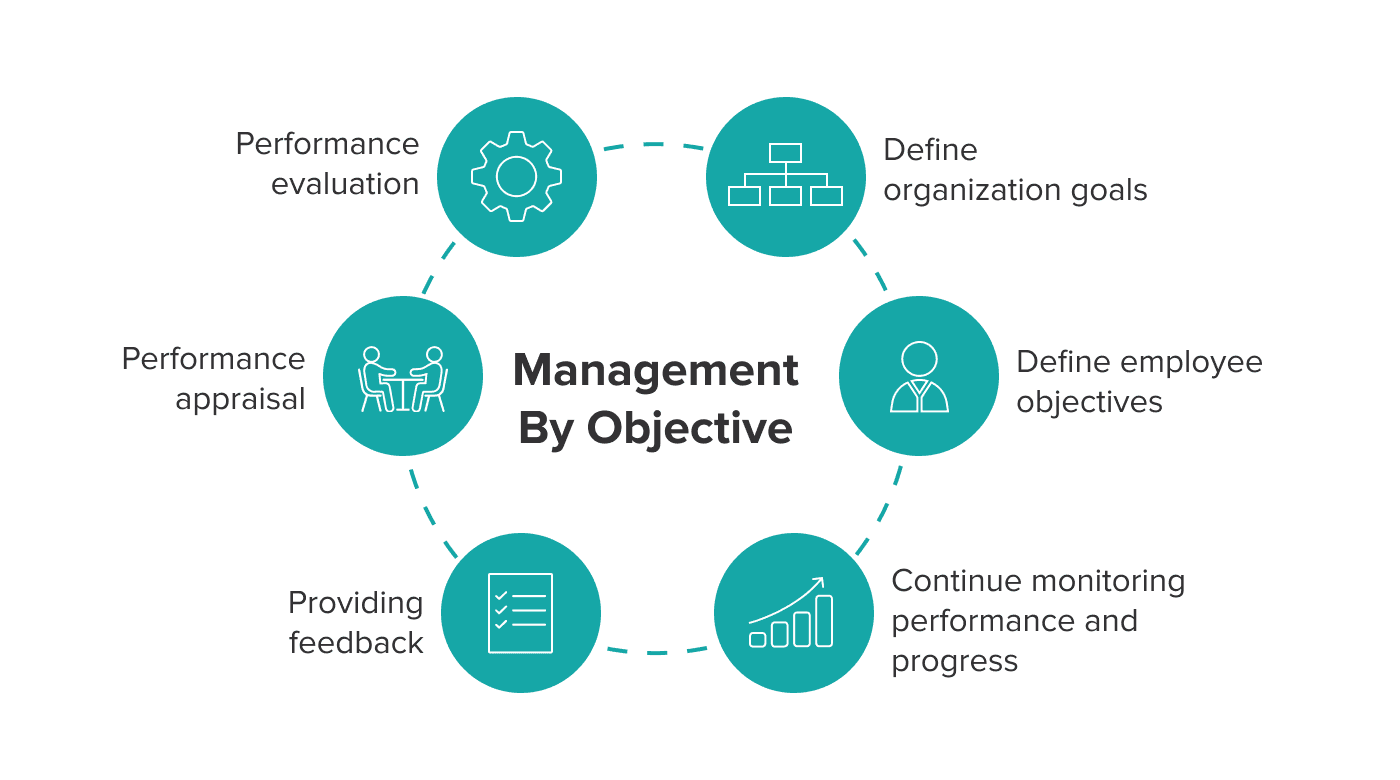
To start using this method, consider the company’s mission or vision statement — what objectives are top priority? From that, create a series of broad objectives. Ensure that employees not only understand how they can help complete these objectives, but they also understand the vision of the company. Using the SMART (specific, measurable, acceptable, realistic, time-bound) acronym can help with this. Each employee will want to know how they can best use their skills specifically to address certain objectives.
Pros
Employees are involved and evaluated based on how well they achieve both their personal goals and the goals of the company. Smaller, achievable goals can boost employee morale.
Employees have a clear purpose and a “why” that pushes them to complete the objectives, beyond just collecting a paycheck.
It creates measurable goals that can be examined at any time (“likes” or “shares” come to mind here). Employees and employers have hard data that can be measured to analyze productivity, and they can see if their goals are being reached in the timeline given.
Cons
With the focus primarily on goals, intangible concepts like company culture, morale, etc. can be ignored. If these are ignored long enough, employee morale will lower, and so will productivity.
It can be stressful for team members as there are hard deadlines.
A stressed out employee may feel the need to go the “by any means necessary” route to hit the target and the quality of their work may suffer because of shortcuts. Or worse, they may start looking for ways to “game” the system and work less.
Behavioral observation scale (BOS)
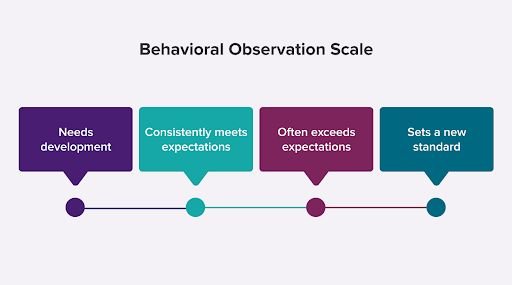
This scale, developed way back in the 1970s by Gary Latham and Ken Wexley, measures behaviors rather than hard objectives. This makes evaluations efficient and opens the floor for employee evaluation comments on their given score. For managers, it’s an easy employee evaluation form to fill out as well.
Pros
It's time-efficient compared to other employee evaluation options. With a scale such as this, there’s no need to “poll the audience” or reach out to team members for their input.
It’s easier to compare results between employees because of its simplicity.
It can also compare results between departments as a tool for evaluating leadership style if employee scores are added up and then averaged. However, this doesn’t consider nuances in style that a particular manager might have.
Cons
This can be very subjective, as beyond a scale of 1–5 or 1–10, there’s no other specific measurement, and emotion can cloud a manager’s judgment.
It can lack detail and nuance. There's nothing in place to explain “why” a particular score is given. This could breed resentment either between colleagues or toward the manager giving the evaluation. This can be reduced by having the manager explain why a particular score was necessary (of course, this costs more time, and doesn’t really fully get rid of the issue).
Management needs to be super attentive. This can be an issue depending on leadership style. If, for instance, the place of work is fast-paced, this may not be the best option to use, since there may not be enough time to truly get to know each person on all of your teams.
Graphic rating scale
A graphic rating scale is used to evaluate performance, productivity, engagement, and “soft skills” such as building rapport with a customer. This method is similar to the BOS above, but the employee evaluation form is far more customizable based on which metrics management wants to look out for and measure in an employee. Instead of saying that an employee’s performance is overall “average,” you can specify, for example, that their quality of work is “usually accurate,” but that their customer support skills are “accurate.” Once the management team has figured out exactly what it is they want to measure about an employee’s performance, they then need to represent each choice visually. They need to make sure to implement clear anchors for each mark, so that the metrics aren’t vague. This way, the employee can know exactly what they need to improve on. As with the above example, one option could be “poor” for suboptimal work, which is very general. A clearer option would be “frequent errors.” With this highly customizable scale, it’s easy to spot patterns in behavior, since management themselves create the criteria that they’d be examining.
Pros
It’s easy to understand and customize due to the visual format. The scale can always be modified based on feedback, or if the scale isn’t clear.
It’s fairly inexpensive to develop, and quick to implement. Just like with the BOS, this method is incredibly efficient.
It’s easy for management to spot patterns in behavior, since they have very specific metrics that were hand-picked based on their importance.
Cons
It’s subjective, and emotion can cloud a manager’s judgment.
If employees are evaluating each other, it has the potential to become…messy unless strict guidelines are in place.
It lacks hard numbers and objectives, which can cause issues with morale, and lead to negative employee evaluation comments.
Doesn’t consider individual employee strength and weaknesses. One employee may be better at a task than another, and they shouldn’t be judged using the same criteria.
Critical incident method (CIM)
The critical incident method of appraisal is used to analyze an employee’s abilities when faced with a specific event or issue that needs solving. Sometimes, the worst happens, and managers may feel inclined to judge employees based on how…well they reacted in certain situations. In this evaluation method, the employee being tested is asked to recollect an instance where a particular behavior, action or event had an impact on a task — whether positive or negative. In this method, you ask directly how they performed, and if they could have performed better. Once the manager has reviewed the “incident” and collected the facts, they then analyze how the project was effected and evaluate how that project could have been improved, and what can be done in the future to improve efficiency and reduce incidents that affect the project.
Pros
It’s specific, and focuses on specific examples of performance with set criteria for the event or events used in the evaluation.
It’s objective, which means there’s less room for personal bias or feelings to get involved. The employee is describing exactly what happened, and the manager is describing exactly what happened, from both sides.
This method helps management to understand the specific incidents that occurred that reduced the efficiency of a task, so they know exactly what to do next time.
Cons
This method can be limiting because it focuses on specific and rigid examples. If an “incident” hasn’t happened yet, how do you know how well your employees will do in case one happens tomorrow?
This can be open to abuse as examples can be cherry-picked, as those same examples can make the employee being evaluated look good or bad, depending on the specifics. The employee may have excelled at one task, but failed to implement another.
Can be stress inducing as employees know they’re being watched. Having to retell the exact specifics of an incident that they know affected productivity can be intense and draining.
Which method is best for your company?
Each method described here has its pros and cons. Your management team will have to decide which works best for their employees and scope. Depending on your company’s goals, your employees’ morale, and your company culture, one method may work better than the others. However, you don’t need to only use one or the other. It may even be best to use a combination of methods to achieve the best results. Mixing and matching might be the way to go here. If done right, by using these evaluation techniques, you’ll foster better morale and a team that functions cohesively and without any drama that causes you more paperwork. If you want to implement these employee valuations or turn HR on autopilot at your company, visit Bambee today.